Why is my self-storage facility gate not opening?
The most common causes of a gate that won't open are: failed loop detector (vehicle not detected at entry), loss of power to the operator, blown control board fuse, failed access control signal, or mechanical obstruction. If the gate is completely unresponsive, check power first. If power is confirmed, call a qualified gate technician — do not attempt to manually force a commercial gate operator.
How long does a commercial gate operator last at a self-storage facility?
A well-maintained commercial gate operator at a self-storage facility typically lasts 10 to 20 years. High-cycle operators rated for heavy-use commercial applications last longer. Preventive maintenance — lubrication, chain tension adjustment, board inspection — significantly extends operator life. Operators that are never serviced commonly fail prematurely at 7 to 10 years.
What gate operator brands do you service?
Storage Maintenance Specialists services LiftMaster, Viking, Linear, Osco, FAAC, DoorKing, and most commercial slide and swing gate operator brands. We carry replacement parts for LiftMaster, Viking, Linear, and Osco — the most common brands in Midwest self-storage facilities.
What is a loop detector and why does my gate need one?
A loop detector is a vehicle detection system embedded in the pavement at your gate entry and exit points. It detects the metal mass of a vehicle and signals the gate operator to open or prevent the gate from closing on a vehicle. Without functioning loop detectors, your gate may fail to open for vehicles or close on top of a vehicle — creating liability and customer complaints. Loop detectors are a critical safety component.
My storage facility gate is closing too fast. Is that a safety issue?
Yes. A gate closing too fast is a safety and liability issue. Commercial gate operators have adjustable close speed settings and must have a functioning obstruction detection system. A gate that closes at unsafe speed may violate UL 325 safety standards. Stop using the gate for vehicle entry until the close speed and safety systems are inspected and corrected.
How do I reset my LiftMaster gate operator after a power outage?
Most LiftMaster commercial gate operators will resume normal operation automatically after power is restored. If the operator does not resume, check the circuit breaker at the operator and the facility panel. If power is restored but the operator is unresponsive, the control board may have experienced a surge. Call Storage Maintenance Specialists at (317) 775-2372.
What is the difference between a slide gate and a swing gate for self-storage?
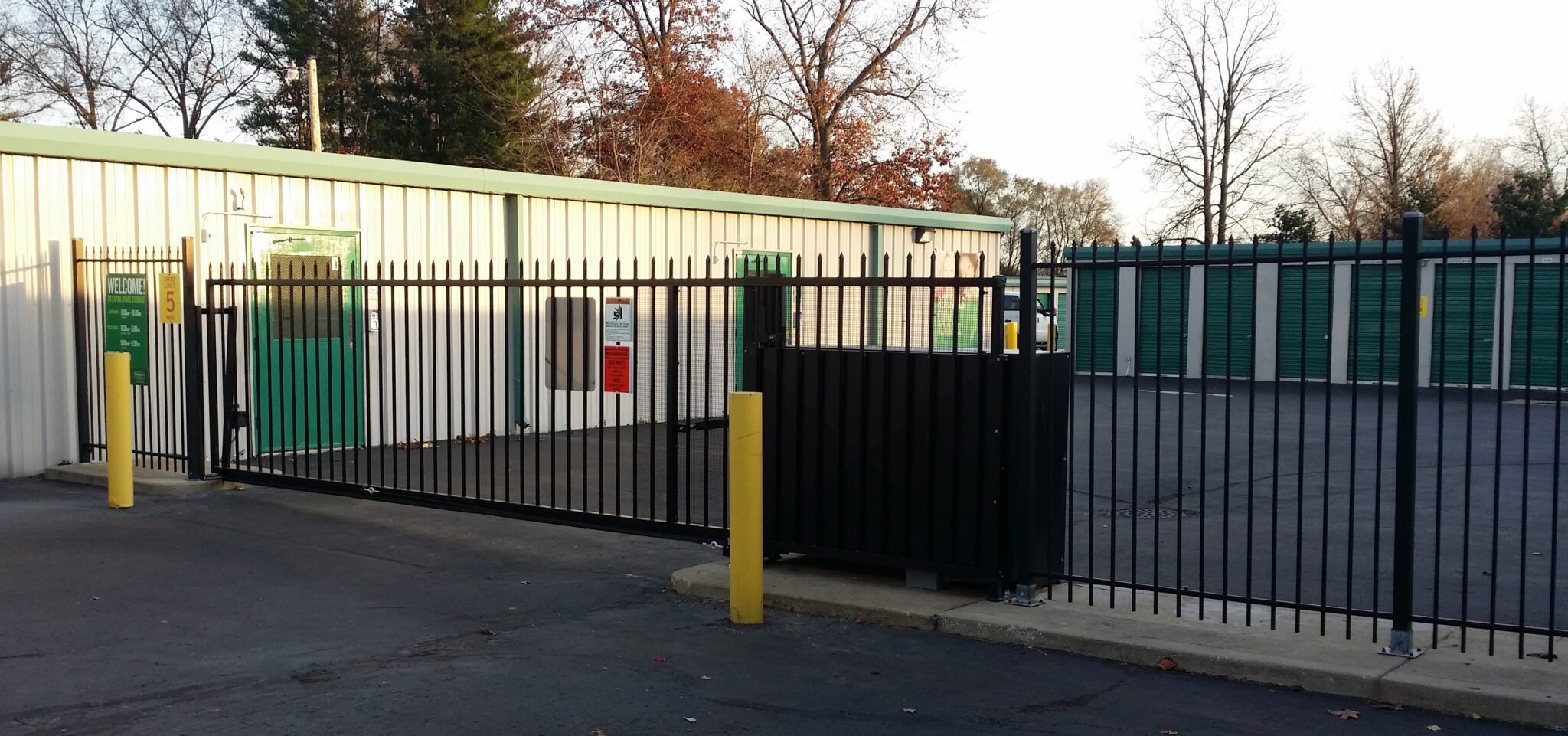
Slide gates roll laterally along a track parallel to the fence line and are the standard for self-storage facilities because they require no arc clearance in front of the gate. Swing gates open inward or outward on hinges and require clear space in the swing arc. Slide gates are preferred for storage applications — they are faster, handle higher cycle counts, and work in tighter entry configurations.
How much does it cost to replace a commercial gate operator at a storage facility?
Commercial slide gate operator replacement cost varies by operator model, amperage requirements, and installation complexity. Factors include whether the existing wiring and conduit can be reused, if the mounting is compatible with the new operator, and access control integration requirements. Contact Storage Maintenance Specialists at (317) 775-2372 for a site-specific quote.
Can you integrate a new gate operator with my existing access control system?
In most cases, yes. Commercial gate operators use standard relay outputs that integrate with virtually all access control systems including PTI, DoorKing, Brivo, OpenEdge, and others common in self-storage. We confirm compatibility before installation and test the full integration — keypad, reader, and loop detectors — before the job is closed.
How often should a self-storage gate operator be serviced?
Annual preventive maintenance is recommended for self-storage gate operators. Service includes lubrication of the drive chain or belt, chain tension adjustment, limit switch verification, control board inspection, safety edge and loop detector testing, and cycle count documentation. High-traffic facilities benefit from semi-annual service.